 11
11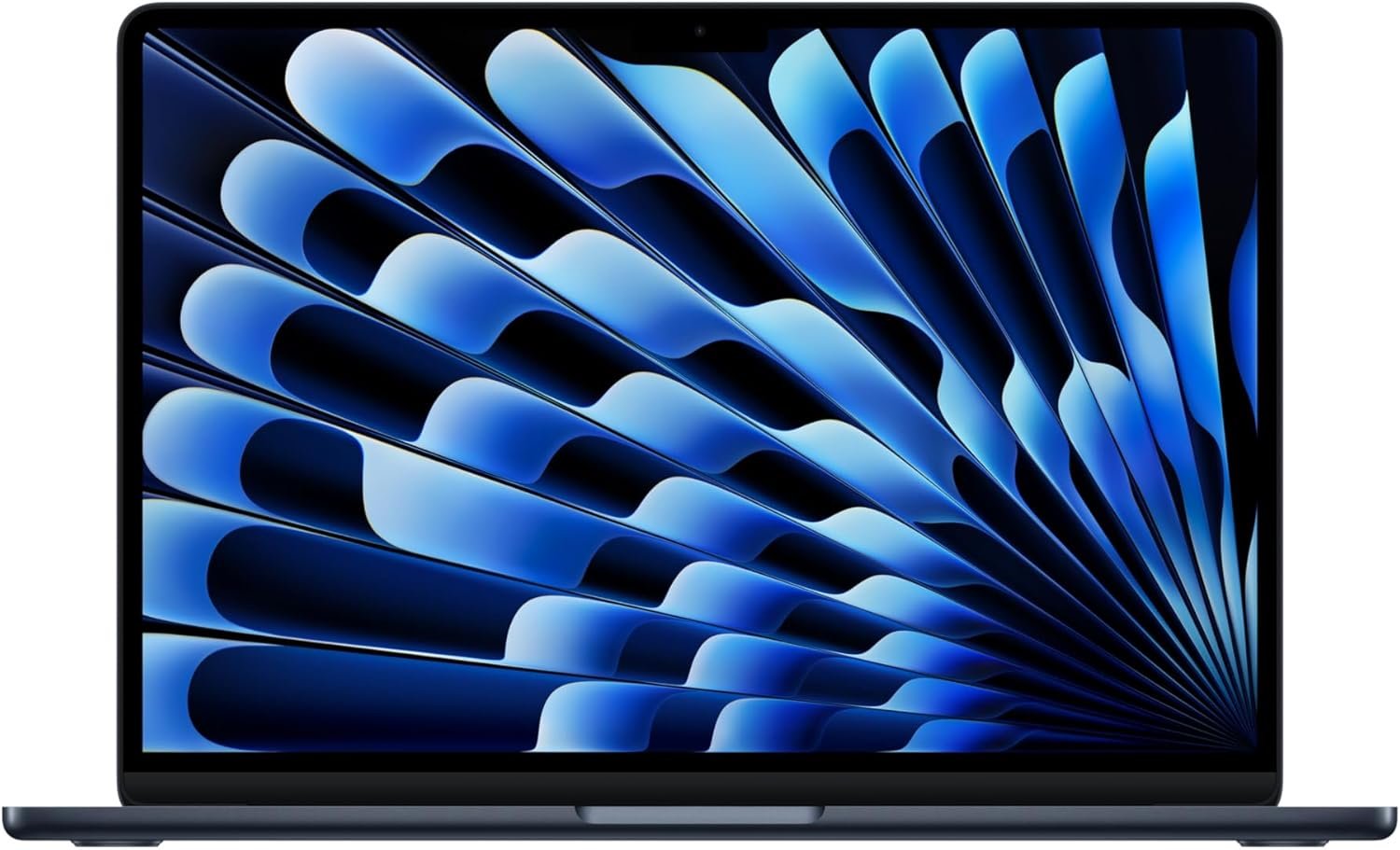
Apple’s 2026 refresh of the 13-inch MacBook Air introduces the Apple M5 chip, marking a significant structural architectural leap in thin-and-light laptop computing. While previous generations established Apple Silicon as the benchmark for fanless efficiency, the M5 era centers heavily on on-device Artificial Intelligence (AI), enhanced graphical rendering, and upgraded system hardware standardizations.
Equipped with double the baseline storage capacity (512GB), 16GB of high-speed unified memory, an upgraded 12MP Center Stage camera, and cutting-edge Wi-Fi 7 wireless networking, the 2026 MacBook Air 13-inch (Midnight) stands as a comprehensive mobile workstation designed for modern computing demands.
| Feature | Specification Details |
| Model | Apple 2026 MacBook Air 13-inch (Model A3449) |
| Processor (SoC) | Apple M5 Chip (3nm process) |
| CPU Architecture | 10 Cores (4 High-Performance “Super” Cores + 6 Efficiency Cores) |
| GPU Architecture | 8-Core or 10-Core Integrated GPU with Neural Accelerators in each core |
| AI Accelerator (NPU) | 16-Core Neural Engine + GPU Neural Accelerators (over 4x peak AI compute vs. M4) |
| Unified Memory | 16GB Standard (LPDDR5X-9600, 153 GB/s memory bandwidth) |
| Solid-State Storage | 512GB NVMe SSD (up to 2x faster read/write speeds over previous generation) |
| Display | 13.6-inch Liquid Retina Display (2560 x 1664 resolution, 224 ppi, 500 nits, P3 Wide Color, True Tone) |
| Camera | 12MP Center Stage Camera with Desk View support & 1080p HD computational video |
| Wireless Connectivity | Apple N1 Chip: Wi-Fi 7 (802.11be), Bluetooth 6.0, Thread Networking |
| I/O Ports | 2x Thunderbolt 4 / USB 4 ports, MagSafe 3 charging port, 3.5mm High-Impedance Headphone Jack |
| Audio | Four-speaker sound system with Spatial Audio & Dolby Atmos; 3-mic array with directional beamforming |
| External Display Support | Supports up to two external displays simultaneously (up to 6K at 60Hz or 4K at 144Hz) |
| Battery & Power | 53.8 Wh battery; up to 18 hours video playback / 15 hours wireless web; fast-charge capable |
| Chassis Dimensions | Height: 0.44 in (1.13 cm) | Width: 11.97 in (30.41 cm) | Depth: 8.46 in (21.5 cm) |
| Weight | 2.7 lbs (1.23 kg) |
| Color Finish | Midnight (Deep Navy-Black anodized aluminum) |
The 2026 MacBook Air is powered by the Apple M5 System-on-Chip (SoC), built using an optimized 3-nanometer semiconductor process node. The CPU configuration features 10 physical cores:
This asymmetric core topology allows the 13-inch MacBook Air to deliver up to 15% faster multithreaded CPU performance compared to M4 processors while maintaining completely fanless, silent thermal management.
  +-------------------------------------------------------------------+
  |                      APPLE M5 SYSTEM ON CHIP (SoC)                |
  |                                                                   |
  |  +---------------------------+   +-----------------------------+  |
  |  |  10-CORE CPU              |   |  GPU WITH NEURAL ACCEL.     |  |
  |  |  - 4 "Super" Cores        |   |  - 8 or 10 Compute Cores    |  |
  |  |  - 6 Efficiency Cores     |   |  - Integrated AI Pipelines  |  |
  |  +---------------------------+   +-----------------------------+  |
  |                                                                   |
  |  +---------------------------+   +-----------------------------+  |
  |  |  16-CORE NEURAL ENGINE    |   |  UNIFIED MEMORY CONTROLLER  |  |
  |  |  - Dedicated NPU Compute  |   |  - 153 GB/s Bandwidth       |  |
  |  +---------------------------+   +-----------------------------+  |
  +-------------------------------------------------------------------+
The primary innovation inside the M5 architecture is its redesigned Graphics Processing Unit (GPU). Unlike traditional GPU setups where AI routines are routed exclusively to a standalone Neural Engine, Apple integrated a dedicated Neural Accelerator into every individual GPU compute block.
System latency is minimized through Apple’s Unified Memory Architecture (UMA). By packaging high-speed LPDDR5X RAM directly alongside the CPU and GPU dies, data doesn’t need to travel across a traditional motherboard bus.
The visual centerpiece of the 13-inch MacBook Air is its high-density 13.6-inch Liquid Retina Display.
  +-------------------------------------------------------------+
  |                                                             |
  |   +-----------------------------------------------------+   |
  |   | [12MP Center Stage Camera + Desk View Sensor]       |   |
  |   |                                                     |   |
  |   |                                                     |   |
  |   |             13.6-inch Liquid Retina                 |   |
  |   |              2560 x 1664 Resolution                 |   |
  |   |              500 Nits Brightness                    |   |
  |   |              P3 Wide Color Spectrum                 |   |
  |   |                                                     |   |
  |   +-----------------------------------------------------+   |
  |                                                             |
  +-------------------------------------------------------------+
For professional environments requiring expanded display real estate, the M5 display engine natively supports up to two external displays over Thunderbolt 4 ports. Users can run two external 6K monitors at 60Hz (or 4K displays at up to 144Hz) simultaneously alongside or without the primary laptop display open.
Addressing the demands of remote collaboration, the 2026 MacBook Air replaces traditional webcams with an advanced 12-Megapixel Center Stage Camera:
Networking capabilities are powered by Apple’s custom N1 wireless networking silicon:
The Midnight finish features a specialized chemical anodization layer designed to reduce surface fingerprint smudges compared to earlier dark finishes. Constructed from 100% recycled aluminum, the chassis maintains structural rigidity while weighing only 2.7 pounds (1.23 kg) with an ultra-thin 0.44-inch (1.13 cm) profile.
The MacBook Air features no internal moving cooling fans. Heat generated by the M5 SoC is distributed evenly across an internal aluminum heat spreader to the outer chassis casing. This guarantees 100% silent operation regardless of CPU/GPU computational load.
To put the technological advancements of the M5 architecture into perspective, the table below compares core performance metrics across generations of 13-inch MacBook Air systems:
| Metric / Specification | Apple M1 (2020) | Apple M4 (2024) | Apple M5 (2026) |
| Process Node | 5nm | 3nm (N3E) | Enhanced 3nm (N3P) |
| CPU Cores | 8 (4P + 4E) | 10 (4P + 6E) | 10 (4 Super + 6 Efficiency) |
| GPU Architecture | 7 or 8 Core | 8 or 10 Core | 8 or 10 Core + GPU Neural Accelerators |
| AI Compute Performance | Baseline | ~2.3x M1 | Over 4x M4 / Up to 9.5x M1 |
| Memory Bandwidth | 68.25 GB/s | 120 GB/s | 153 GB/s |
| Base Storage Capacity | 256GB SSD | 256GB SSD | 512GB NVMe SSD |
| Camera Hardware | 720p FaceTime HD | 12MP Center Stage | 12MP Center Stage + Desk View |
| Wireless Standard | Wi-Fi 6 / BT 5.0 | Wi-Fi 6E / BT 5.3 | Wi-Fi 7 / BT 6.0 (Apple N1 Chip) |
| External Displays | 1 External Display | 2 External Displays | 2 External Displays (up to 6K/8K options) |
With 16GB of standard unified memory, 153 GB/s bandwidth, and dedicated GPU Neural Accelerators, the M5 MacBook Air is optimized for running localized machine learning models:
Hardware ray tracing and dynamic caching allow digital creators to execute graphics tasks previously restricted to thick pro-grade laptops:
The 2026 Apple MacBook Air 13-inch with M5 chip brings together hardware performance, energy efficiency, and modern display tech. By introducing standard 512GB storage, 16GB unified memory, Wi-Fi 7 connectivity, a 12MP Center Stage camera, and GPU-integrated AI accelerators, Apple has created a versatile ultra-portable laptop capable of handling both daily computing and demanding next-gen software workloads.